The Intelligent Surveillance Revolution
The global AI camera market, valued at USD 12.42 billion in 2025, is on a trajectory to surpass USD 78.72 billion by 2034, expanding at a compound annual growth rate (CAGR) of 22.81%. This explosive growth signifies a fundamental shift: security is moving from passive recording to intelligent, proactive threat prevention. AI security cameras are no longer a novelty but a core component of modern security infrastructure, transforming how organizations and individuals protect people, assets, and data.
This guide provides a comprehensive analysis of AI-powered surveillance. We’ll define the technology, explore its advanced capabilities and diverse applications, examine the critical benefits and challenges, and offer strategic advice for successful implementation.
Understanding AI Security Cameras: Beyond Simple Recording
An AI security camera is a video surveillance device that uses artificial intelligence algorithms, primarily based on machine learning and computer vision, to analyze footage in real-time. Unlike traditional CCTV that merely records for later review, these systems actively interpret the visual scene, learn what constitutes “normal” activity, and identify anomalies or predefined objects of interest.
Core Technology Shift: From Seeing to Understanding
The core technological shift is the move from “seeing” to “understanding.” This is enabled by two key components:
- Advanced Hardware: High-resolution sensors coupled with specialized onboard processors (like GPUs or AI accelerators) that handle intensive computations. This allows for edge computing, where analysis happens on the camera itself, reducing latency and bandwidth use.
- Sophisticated Software: Deep learning models trained on massive datasets to recognize patterns, classify objects, and detect behaviors. A key trend for 2025 is the significant evolution toward continuous learning AI models that adapt over time to their specific environment, rather than relying on static, one-time training.
Core AI Capabilities and Features
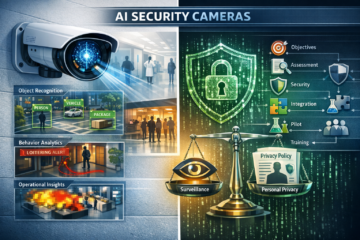
Modern AI security cameras offer a suite of analytics that form the backbone of intelligent surveillance. Key capabilities include:
| Feature Category | Key Capabilities | Primary Benefit |
|---|---|---|
| Object Recognition & Classification | Identifies and categorizes objects as people, vehicles, animals, bags, etc. | Drastically reduces false alarms by filtering irrelevant motion (e.g., leaves blowing). |
| Behavioral & Anomaly Detection | Analyzes patterns to detect loitering, falls, trespassing, crowd formation, or unusual motion. | Enables proactive security by identifying potential threats before they escalate. |
| Biometric & Identification Analytics | Includes facial recognition and License Plate Recognition (LPR). | Controls access, identifies persons or vehicles of interest, and automates entry/exit logging. |
| Environmental & Audio Sensing | Detects environmental changes (smoke, fire) or specific sounds (glass breaking, gunshots). | Expands security monitoring beyond visual data to provide comprehensive situational awareness. |
| Operational Insights | Provides crowd density analysis, people counting, and heat mapping. | Supports business intelligence, space optimization, and compliance with occupancy limits. |
A key trend for 2025 is the integration of Generative AI (GenAI) into video analytics workflows. While not replacing core detection models, GenAI is being used to generate natural-language summaries of incidents, automate reporting, and even create synthetic data to train models for rare but critical scenarios.
Transformative Applications Across Industries
The versatility of AI analytics allows for tailored solutions in nearly every sector. Here are some of the most impactful applications:
- Commercial & Corporate Security: Beyond basic intrusion detection, AI cameras integrate with access control systems to prevent tailgating, monitor for unsafe conditions, and protect sensitive areas. They also provide insights into space utilization and facility management.
- Critical Infrastructure & Public Safety: Used to protect power plants, transportation hubs, and public spaces. AI cameras enable real-time crowd monitoring, traffic flow analysis, and immediate detection of safety hazards or unattended objects.
- Retail & Hospitality: These sectors leverage AI for loss prevention, customer behavior analysis (dwell time, popular pathways), and optimizing store layouts or service delivery. They can also help ensure compliance with health and safety protocols.
- Healthcare & Education: In these sensitive environments, the focus is on safety and rapid response. Applications include patient fall detection in hospitals, monitoring restricted areas, and in schools, advanced systems capable of weapon detection to trigger immediate lockdowns and alerts.
- Smart Cities & Residential: AI cameras manage traffic congestion, detect accidents, and enhance public space security. For homes, they offer package theft prevention, personalized alerts for familiar vs. unfamiliar faces, and integration with other smart home devices.
Tangible Benefits and Measurable ROI
Investing in an AI security camera system delivers returns across several dimensions:
- Enhanced Security Efficacy: AI systems can improve threat detection rates while reducing false alarms by up to 90%. This allows security personnel to focus on genuine incidents, leading to faster and more effective responses.
- Operational and Cost Efficiency: Automation of monitoring tasks reduces the manpower needed for constant video review. Furthermore, the operational insights gained (e.g., process bottlenecks in a warehouse, peak retail hours) can drive efficiencies beyond the security department.
- Proactive Risk Mitigation: By identifying suspicious behavior (like loitering near a fire exit or repeated perimeter testing), these systems enable intervention before a crime or accident occurs, shifting security from reactive to preventative.
- Improved Investigative Efficiency: Searching through days of footage for a specific event can take hours. AI systems allow investigators to quickly search for “red car,” “person with backpack,” or activity within a defined zone and time frame, slashing investigation times.
Critical Challenges and Responsible Implementation
Despite their advantages, deploying AI surveillance requires navigating significant technical, ethical, and operational challenges.
Privacy and Ethical Considerations
The enhanced tracking and identification capabilities of AI cameras raise legitimate privacy concerns. Public sentiment and regulations are increasingly sensitive to unchecked surveillance. Best practices include implementing privacy-by-design principles, such as on-device anonymization of non-threat individuals, strict data retention policies, and transparent communication about what data is collected and how it is used.
Data Security and Systemic Vulnerabilities
AI camera systems are part of the IT infrastructure and are vulnerable to cyber threats. Ensuring network segmentation, regular firmware updates, and strong encryption for data in transit and at rest is non-negotiable.
Algorithmic Bias and Accuracy
AI models are only as good as the data they are trained on. If training data lacks diversity, systems can exhibit bias, leading to higher error rates for certain demographics. It’s crucial to select vendors that prioritize diverse training sets, provide transparency about model performance, and allow for human oversight of critical decisions.
Integration and Total Cost of Ownership
While long-term savings are clear, upfront costs for advanced AI cameras and the required infrastructure (e.g., network upgrades, compatible VMS) can be higher. Ensuring new systems can integrate seamlessly with existing access control, alarms, and communication systems is key to maximizing value and avoiding operational silos.
The Future of AI Security: Continuous Learning and Predictive Analytics
The next frontier is the move from static AI to continuous learning systems. Traditional models are “frozen” after deployment and degrade as environments change. The next generation uses technologies like online learning and federated learning to adapt continuously to new data, maintaining high accuracy through seasonal changes, new construction, or evolving threat patterns.
Looking ahead, we can expect:
- Predictive Analytics: Systems that move beyond detecting active threats to identifying precursor patterns and predicting potential security incidents.
- Converged Security Ecosystems: Deeper integration between video analytics, access control, cybersecurity tools, and IoT sensors to create a unified security intelligence platform.
- Advancements in Edge AI: More powerful and efficient processing directly on cameras, enabling more complex analytics without latency or bandwidth constraints.
Strategic Implementation Checklist
Before deploying an AI security camera system, consider these steps:
- Define Clear Objectives: Identify specific problems you need to solve (e.g., reduce theft, speed up emergency response, ensure compliance).
- Conduct a Privacy Impact Assessment: Develop clear policies on data use, retention, and access. Engage with stakeholders (employees, community) to address concerns.
- Prioritize Security Hygiene: Choose vendors with a strong commitment to cybersecurity, mandate strong passwords and network segregation, and plan for regular security audits.
- Plan for Integration: Ensure new cameras are compatible with your existing Video Management System (VMS) and other security infrastructure. Opt for open-architecture systems where possible.
- Start with a Pilot: Deploy the system in a limited area to evaluate its accuracy, ease of use, and ROI before scaling across your entire operation.
- Train Your Team: Ensure security personnel understand how to use AI-generated alerts effectively and maintain appropriate human oversight.
Conclusion
AI security cameras represent a powerful tool for building safer, more efficient environments. Their value extends far beyond traditional surveillance into operational intelligence and proactive risk management. However, their power must be balanced with a responsible framework that prioritizes ethical deployment, robust data security, and continuous human oversight. By understanding both the profound capabilities and the serious responsibilities inherent in this technology, organizations can harness AI to create a safer future.
Further Resources: For more information on market trends, you can explore reports from leading research firms. To understand ethical frameworks, resources from institutions like the Future of Privacy Forum or the IEEE Global Initiative on Ethics of Autonomous and Intelligent Systems are valuable starting points.